
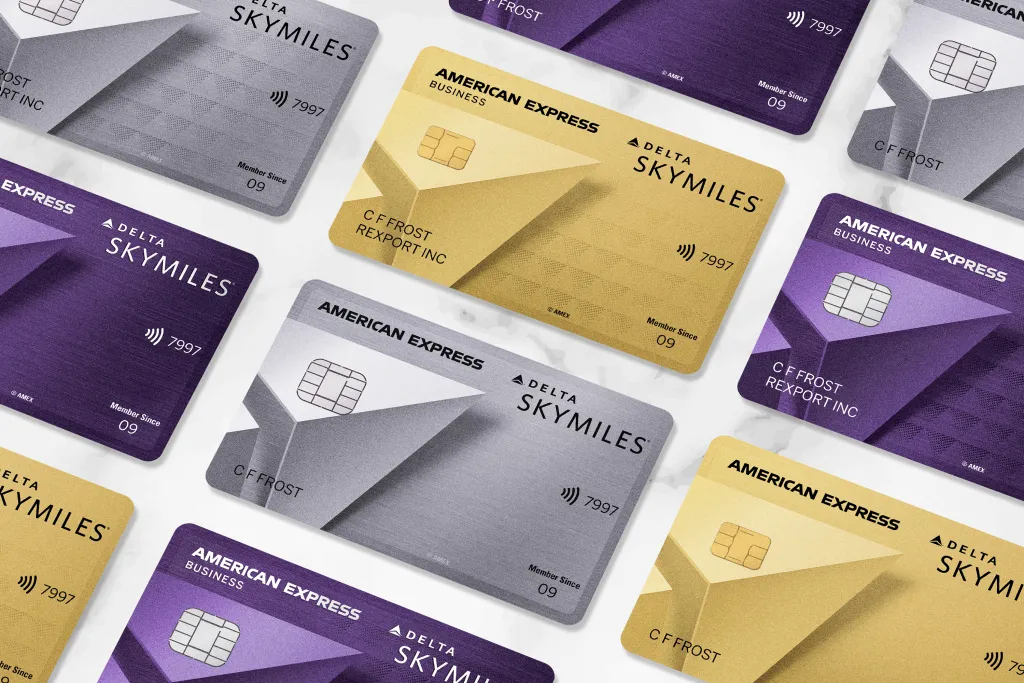
You can browse through airline cards with benefits like free checked bags, lounge access, and more here. Sort by your preferred airline to browse.
The best Delta credit card is a niche tool, not a default travel card. Most of the internet treats co-branded airline cards like they belong in every points strategy, and that’s how people end up paying $650 a year for perks they don’t actually use. Airline cards only genuinely earn their fees in two specific scenarios, and if you don’t fit one of them, a flexible rewards card will serve you better.
The two scenarios where a Delta card makes sense: you fly Delta in Main Cabin frequently, where the free checked bag, priority boarding, and TAKEOFF 15 discount add up to real money several times a year. Or you travel with a partner often enough that the Companion Certificate alone covers the annual fee and then some. That’s it. Outside those two use cases, a Delta card is mostly a branded piece of plastic that quietly drains your bank account.
This post walks through all four Delta Amex consumer cards and their business counterparts, but the framing matters more than any individual card recommendation. Read the first section, decide which scenario you fall into (or neither), and then the right card picks itself.
When a Delta Credit Card Actually Earns Its Keep
There are only two honest cases for carrying a co-branded Delta card, and they both have nothing to do with earning extra miles.
Scenario one: you fly Delta Main Cabin several times a year. This is where airline cards win. A round-trip first checked bag costs around $70 on most domestic Delta routes, and the free checked bag benefit extends to up to eight companions on the same reservation. Fly twice a year with a partner and two bags, and you’re looking at roughly $140 to $280 in bag fees the card absorbs. Add priority boarding, 20% back on in-flight purchases, and the 15% discount on award redemptions, and a $150 annual fee pays for itself without effort. The cards get progressively more valuable the more frequently you fly Main Cabin, because the per-trip savings compound. If you fly Delta six times a year in Main Cabin, the math will be in your favor.
Scenario two: you travel with a partner and will use a Companion Certificate every year. This is the single most valuable annual perk in the Delta lineup, and it’s only available on the Platinum, Platinum Business, Reserve, and Reserve Business. One certificate used on a peak-period domestic round-trip can return $400 to $1,200 in value for the taxes-and-fees cost alone ($22 to $250 per Delta’s disclosure). If you and a partner routinely travel together, the Companion Certificate can cover the Platinum’s $350 fee twice over in a single use, and still leave room for other benefits to pile on top. If you don’t travel with a consistent companion, this benefit is worth exactly zero dollars.
When A Delta Card Doesn’t Make Sense
If you frequently fly business or premium cabin, internationally or domestically. Business class already includes two free checked bags. You already board in an early zone. You usually have lounge access through your fare class or through a separate premium card like the Amex Platinum. The entire value proposition of a co-branded airline card dissolves when the airline is already giving you the perks included in your fare.
The Companion Certificate is domestic and Main Cabin (Platinum) or Main/Comfort+/First (Reserve), so it’s of limited utility if your travel pattern is international business class.
The Three Benefits That Do the Heavy Lifting
Before walking through the individual cards, it’s worth understanding the three benefits that actually matter. Everything else is marketing (sorry, Delta).
TAKEOFF 15 gives Gold, Platinum, and Reserve cardholders (and their business variants) 15% off the mileage cost of Delta-operated Award Travel booked through delta.com or the Fly Delta app. Not combinable with certificates, eCredits, or other promotions. Not applicable to partner-operated flights or taxes and fees. The Blue card does not qualify. On a 50,000-mile round-trip award, TAKEOFF 15 drops the cost to 42,500 miles. Book four Delta awards in a year and you’ve recovered 30,000 miles, which is another domestic round-trip.
The Companion Certificate is available only on the Platinum, Platinum Business, Reserve, and Reserve Business. The Gold does not include one. Platinum certificates are valid in Main Cabin only, for domestic, Caribbean, or Central American round-trips. Reserve certificates extend to Delta First, Delta Comfort+, or Main Cabin on the same geography. Pay only government-imposed taxes and fees ($22 to $250). If you use it once during a peak-demand period, it can return more value than the card’s annual fee on its own.
Free first checked bag and priority boarding are available on Gold, Platinum, and Reserve. The bag benefit extends to up to eight companions on the same reservation. Priority boarding puts you in Zone 5, ahead of general boarding, which matters for overhead bin space on packed flights. These are the benefits that make the math work for frequent Main Cabin flyers.
Pay with Miles is available on all four consumer cards and lets you redeem miles at a fixed 1 cent per mile against any Delta-operated flight. It’s a useful flexibility tool but not a reason to pick one card over another.
Delta SkyMiles Blue American Express: For Almost No One
The Blue card has no annual fee and a 10,000-mile welcome bonus after $1,000 in spend in the first six months. It earns 2x miles on Delta purchases and 1x on everything else.
Honest take: the Blue rarely belongs in anyone’s wallet. It doesn’t include TAKEOFF 15. It doesn’t include a Companion Certificate. It doesn’t include free checked bags. It doesn’t include priority boarding. The only Delta-specific benefit beyond base mile earning is Pay with Miles, which every Delta cardholder gets. A flexible no-annual-fee card like a Chase Freedom or a Citi Double Cash earns more miles per dollar overall and gives you optionality across any airline.
The only legitimate use case for the Blue is someone who wants a Delta-branded card, refuses to pay any annual fee ever, and doesn’t want the Gold’s first-year $0 offer for some reason. That’s a narrow group. Almost everyone else should skip it.
Delta SkyMiles Gold American Express: For the Frequent Main Cabin Flyer Who Doesn’t Travel With a Partner
The Gold fits scenario one from earlier. The welcome offer usually ranges between 50,000 and 80,000, with a $0 introductory annual fee for the first year, then $150 thereafter. It earns 2x at restaurants worldwide and U.S. supermarkets, 2x on Delta purchases, and 1x on everything else.
The benefit stack is focused: TAKEOFF 15 on award bookings, free first checked bag for you and up to eight companions on the same reservation, Zone 5 priority boarding, 20% back on in-flight purchases, and a $200 Delta Flight Credit after spending $10,000 on the card in a calendar year.
What the Gold does not include: a Companion Certificate. That’s the critical distinction. If you travel alone or with family members who already have their own Delta cards, the Gold gives you the core Main Cabin benefits without the $350 or $650 fee. If you travel with a consistent partner and would use a Companion Certificate annually, you’re leaving meaningful value on the table by picking the Gold instead of the Platinum.
For the solo Delta flyer or the flyer who shares travel with multiple people (family of four where everyone has their own card), the Gold is usually the right pick. The first-year fee waiver makes it nearly risk-free to test whether you actually fly Delta enough to justify the ongoing $150.
Delta SkyMiles Platinum American Express: For the Couple Who Travels Together Several Times a Year
The Platinum is where scenario two starts making financial sense. $350 annual fee, welcome offer up to 80,000 miles after $3,000 in spend in the first six months. Earns 3x on Delta purchases and eligible hotel purchases, 2x at restaurants and U.S. supermarkets, 1x on everything else. 1.5x on single purchases over $5,000 (capped at $100,000 per year).
The defining benefit is the Companion Certificate for a Main Cabin domestic, Caribbean, or Central American round-trip, issued every year after renewal. Used once on a peak-period $500 fare, it returns approximately $480 in value net of the $22 minimum taxes and fees. That single use covers $130 more than the annual fee. Used on a $900 holiday fare, the math gets significantly better.
Additional benefits: TAKEOFF 15 (same as Gold), free checked bag, priority boarding, Global Entry or TSA PreCheck fee credit, MQD Headstart of $2,500 toward Medallion status, MQD Boost at $1 MQD per $20 spent, plus statement credits including $200 Delta Stays, $120 Rideshare, and $120 Resy.
What the Platinum does not include: Sky Club access. That benefit was removed on January 1, 2024. If you want Delta lounge access, you need the Reserve or a separate Amex Platinum card (the regular Amex Platinum is my personal pick here).
The Delta Platinum is the right pick for the traveler who fits scenario two (regular travel with a partner) and flies Main Cabin. It’s also appropriate for the Main Cabin flyer trying to qualify for Silver or Gold Medallion status, where the MQD Headstart and Boost materially accelerate the qualification timeline. Anyone considering the Platinum primarily for lounge access is shopping for the wrong card.
Delta SkyMiles Reserve American Express: For the Delta Loyalist Who Wants the First-Class Companion Certificate
The Reserve is the only Delta consumer card that makes sense for anyone who values domestic lounge access. $650 annual fee, welcome offer up to 100,000 miles after $5,000 in spend in the first six months. Earns 3x on Delta purchases, 1x on everything else.
Benefit stack: TAKEOFF 15, Delta Sky Club access with 15 visits per Medallion Year (unlimited after $75,000 in calendar-year spend), complimentary Centurion Lounge and Escape Lounge access when flying Delta and booking with the card, a significantly upgraded Companion Certificate valid in Delta First, Delta Comfort+, or Main Cabin on domestic, Caribbean, and Central American routes, MQD Headstart of $2,500, MQD Boost at $1 MQD per $10 spent, and $560 in annual statement credits ($200 Delta Stays, $240 Resy, $120 Rideshare).
The Reserve’s Companion Certificate is the most valuable version in the Delta lineup. Using it on a Delta First domestic round-trip during summer or holidays, where cash fares can exceed $1,200, returns $1,000+ in value net of taxes. That single use covers over 150% of the annual fee.
Here’s where the Reserve complicates the two-scenario framework: if you primarily fly Delta business or premium cabin, you don’t need the free bag or Zone 5 boarding, but you might still value the Reserve for the Companion Certificate upgrade to First class and for Sky Club access when connecting. This is the one case where a premium cabin flyer might still justify a Delta card, specifically the Reserve, specifically if they travel consistently with a partner.
For the Main Cabin flyer who fits scenario one and scenario two and flies Delta at least monthly, the Reserve earns its fee. For anyone less Delta-concentrated, the Reserve is overkill.
Delta Gold vs. Platinum vs. Reserve
The three Delta SkyMiles Amex cards worth considering, side by side
| Benefit | Gold | Platinum | Reserve |
|---|---|---|---|
| Annual Fee | $0 / $150 | $350 | $650 |
| Miles on Delta | 2x | 3x | 3x |
| Miles on Restaurants & U.S. Supermarkets | 2x | 2x | 1x |
| Miles on Hotels (direct) | 1x | 3x | 1x |
| TAKEOFF 15 (15% off awards) | Yes | Yes | Yes |
| Companion Certificate | No | Main Cabin | First / Comfort+ / Main |
| Free First Checked Bag | Yes | Yes | Yes |
| Priority Boarding (Zone 5) | Yes | Yes | Yes |
| Sky Club Access | No | No | 15 visits / Unlimited at $75K spend |
| Centurion Lounge Access | No | No | Yes (flying Delta) |
| Global Entry / TSA PreCheck Credit | No | Yes | Yes |
| MQD Headstart | No | $2,500 | $2,500 |
| MQD Boost | No | $1 per $20 | $1 per $10 |
| Delta Flight Credit | $200 at $10K spend | No | No |
| Annual Statement Credits | None | $440 (Stays, Resy, Rideshare) | $560 (Stays, Resy, Rideshare) |
| Best For | Main Cabin flyer, travels solo | Main Cabin flyer with a partner | Monthly Delta flyer with a partner |
Benefits accurate as of publication. Terms apply. See delta.com for full details.
The Honest Comparison: Delta Reserve vs. Amex Platinum
If your primary reason for wanting the Reserve is lounge access, the Amex Platinum is almost certainly the better card, even at its $895 annual fee versus the Reserve’s $650.
The lounge math alone tilts this decisively. The Amex Platinum gives you 10 Delta Sky Club visits per Medallion Year when flying Delta, unlimited after $75,000 in calendar-year spend. On top of that, you get unlimited Centurion Lounge access (no Delta flight required), Priority Pass Select membership, Escape Lounges, and the broader Global Lounge Collection (1,550+ lounges in 140 countries). The Reserve gives you 15 Sky Club visits and Centurion Lounge access only when flying Delta and booking with the Reserve card. Five extra Sky Club visits versus dramatically broader lounge access globally, including lounges in airports where Delta doesn’t even fly.
The $200 airline fee credit on the Amex Platinum closes the fee gap significantly. Select Delta as your airline, and the credit reimburses incidentals like bag fees, in-flight purchases, and Sky Club day passes for companions. For someone who would otherwise be paying these out of pocket on Delta, the $200 credit effectively brings the Amex Platinum’s net cost to around $695, versus the Delta Reserve’s $650.
Additional Amex Platinum credits stack further: $200 Uber Cash, $600 hotel credit at Fine Hotels + Resorts, $400 Resy credit, $300 Equinox credit, $240 digital entertainment, $200 Saks (ending July 2026), plus $189 CLEAR membership and $155 Walmart+. Not all of these apply to every traveler, but a Delta flyer who uses even $400 to $600 of these annually has a card that delivers more net value than the Reserve.
What the Delta Reserve still wins on: the Companion Certificate. The Amex Platinum does not include one, and this is the single benefit that can tip the Reserve ahead for a very specific traveler. If you travel domestically with a partner, in premium cabin (Delta First or Comfort+), and will reliably use the Companion Certificate every year, the Reserve’s First-class Companion Certificate can deliver $800 to $1,200 in single-use value. That alone can justify carrying the Reserve alongside (or instead of) the Amex Platinum.
The honest decision tree: if lounge access is your primary motivation, get the Amex Platinum. If the Companion Certificate is your primary motivation and you fly Delta premium cabin domestically with a partner, get the Reserve. If you want both, many Delta loyalists actually carry both cards and stack the lounge visits (25 Sky Club visits per year combined), though that’s a $1,545 combined annual fee that only pencils out for serious travelers using the bulk of the statement credits.
For most Delta flyers weighing “should I get the Reserve for lounge access,” the honest answer is: get the Amex Platinum instead.
Delta Business Credit Cards
The business lineup mirrors the consumer cards but with better welcome offers and tweaked spending categories. The same two-scenario framework applies: the cards earn their fees only if you fly Delta frequently in Main Cabin or travel regularly with a companion.
Delta SkyMiles Gold Business American Express: $0 intro annual fee for the first year, then $150. Earns 2x on Delta, 2x at restaurants worldwide, 2x on U.S. shipping and advertising purchases (capped at $50,000 per category per year), 1x on everything else. Same core benefits as the consumer Gold: TAKEOFF 15, free first checked bag, priority boarding, $200 Delta Flight Credit after $10,000 in annual spend. No Companion Certificate.
Delta SkyMiles Platinum Business American Express: $350 annual fee. Earns 3x on Delta, 3x on direct hotel purchases, 1.5x on transit, U.S. shipping, and single eligible purchases over $5,000 (capped at $100,000 per year). Same Companion Certificate as the consumer Platinum (Main Cabin domestic/Caribbean/Central America), same MQD benefits, Hertz Five Star Status.
Delta SkyMiles Reserve Business American Express: $650 annual fee. Earns 3x on Delta, 1.5x on transit/shipping/office supply stores, plus 1.5x on all purchases after $150,000 in annual spend. Sky Club and Centurion Lounge access match the consumer Reserve. Hertz President’s Circle Status. Companion Certificate upgraded to Delta First/Comfort+/Main.
If you have legitimate business travel spend and fit scenario one or two, the business versions typically deliver better value per dollar of fee than the consumer cards. The higher welcome offers and business-specific spending categories tilt the math. Business Amex cards typically don’t count against the 5-card personal limit, though confirm with your specific Amex situation before applying.
The Scenario That Matters Most: Premium Cabin Flyers
A significant chunk of readers considering a Delta card are flying business or Delta One regularly. The conventional take is that a Delta co-branded card is redundant for premium cabin flyers because the fare itself includes checked bags, priority boarding, and lounge access. That’s partially right, but it misses where the real value lives for this traveler.
Premium cabin flyers accrue miles fast. A single Delta One round-trip to Europe or Asia can deliver 30,000 to 60,000 base miles depending on the route, and that’s before any card spend. When you’re redeeming miles for premium cabin awards that cost 150,000 to 300,000+ miles per ticket, TAKEOFF 15’s 15% discount becomes one of the most valuable benefits in the entire Delta ecosystem. A 200,000-mile business class award drops to 170,000 miles. That’s 30,000 miles saved on a single booking, which is nearly enough for another domestic round-trip. Across two or three premium cabin redemptions per year, TAKEOFF 15 alone can return tens of thousands of miles in value.
For this reason, the Delta SkyMiles Gold is often the right card even for the frequent premium cabin flyer. $150 a year for TAKEOFF 15 access (plus free checked bags on the rare occasions you’re not flying in a cabin that includes them) is a small fee relative to what the benefit returns. The first-year waiver makes it nearly free to add.
The Companion Certificate is the second argument for going beyond the Gold. If you consistently travel domestically with a partner and will use a Companion Certificate every year, the Reserve’s First/Comfort+/Main Cabin certificate can return $800 to $1,200+ per use on peak-demand premium cabin fares. The Platinum’s Main Cabin Companion Certificate is less valuable for a premium flyer because you’re probably booking in a higher cabin anyway, making the upgrade to Reserve worthwhile if you want the benefit at all.
Where premium cabin flyers should skip Delta cards entirely: if you’re already covered for lounge access through an Amex Platinum and you don’t travel domestically with a partner, the Reserve’s benefits largely duplicate what you have. In that case, route your spending through a flexible rewards card. The Chase Sapphire Preferred® earns 2x on all travel and 3x on dining for $95 per year. The Amex Gold earns 4x on restaurants and U.S. supermarkets. Both transfer to Delta when you need it.
The decision for premium cabin flyers simplified: get the Gold for TAKEOFF 15 if you redeem miles for Delta premium awards. Upgrade to Reserve if you also want the First-class Companion Certificate and some Sky Club access. Skip Delta cards entirely if you’re not redeeming Delta miles or traveling with a consistent companion.
The Bottom Line
The best Delta credit card for you is either a Gold, Platinum, or Reserve, or nothing. The Blue is almost never the right answer. Premium cabin flyers who don’t travel with a consistent partner should generally skip Delta cards entirely and pick up a flexible currency card that happens to transfer to Delta.
Airline cards earn their place in a strategy when the benefits actually apply to how you fly. Free checked bags only help if you check bags. Priority boarding only helps if you’re not already boarding early. Lounge access only helps if you don’t already have it. The Companion Certificate only helps if you have a companion. Match the card to how you actually travel, not how you imagine you’ll travel once you’re a “points person.”
If you fit scenario one or scenario two, pick the card in that tier. If you don’t, save the annual fee and route your spending through a flexible rewards program instead. Either decision is more honest than defaulting into a Delta card because “the marketing is pretty “you like to fly Delta”.
You can browse through airline cards with benefits like free checked bags, lounge access, and more here. Sort by your preferred airline to browse.


Leave a Reply